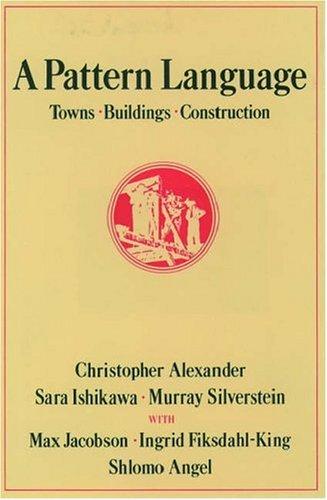
A pattern language
1977
- symbolism in architecture
- town planning
- semiotics
- long now manual for civilization
- city planning
- human factors
- architecture
- language and languages, study and teaching
- aesthetics
- social aspects
The story
Alexander and his co-authors present us with over two hundred (roughly 250) "patterns" that they believe must be present in order for an environment to be pleasing, comfortable, or in their words, "alive." The patterns start at the most general level -- the first pattern, "Independent Regions," describes the ideal political entity, while another of my favorite patterns, "Mosaic of Subcultures," described the proper distribution of different groups within a city. The patterns gradually become more specific -- you'll read arguments about how universities should relate to the community, the proper placement of parks, the role of cafes in a city's life. If you wonder about the best design for a home, the authors will describe everything from how roofs and walls should be built, down to how light should fall within the home, where your windows should be placed, and even the most pleasant variety of chairs in the home. An underlying theme of all the patterns is that architecture, at its best, can be used to foster meaningful human interaction, and the authors urge us to be aware of how the houses we build can help us balance needs for intimacy and privacy.
What it’s like
A dense, diagrammed manual with a calm, instructive voice: each of its roughly 250 short entries opens with a bold heading, a photograph or sketch, and a plain-spoken argument, so the reading rhythm is brisk and modular, like walking through a series of rooms rather than following a story. The sensory world is architectural and humane: sun falling across a kitchen table, a bench under a tree at the edge of a square, the give of a porch step, cafés spilling warmth onto a street. The prose is confident without being grand, often gently exasperated with modern sprawl and tender about gardens, thresholds and window seats. Its vibe is warm, thoughtful and slightly utopian, a quiet Sunday-afternoon read with a notebook close by, or something to dip into late at night when you want to imagine a better street. Intensity is nil: no violence, no fear, no sexual content, only argument and reflection. Best for readers who love cities, houses and small domestic details, designers and students, and anyone who wants to think about how places make people feel close or apart.
More books like A pattern language
Closest in mood, pacing and theme. Tell us why you loved A pattern languageand we’ll explain which ones fit you.


