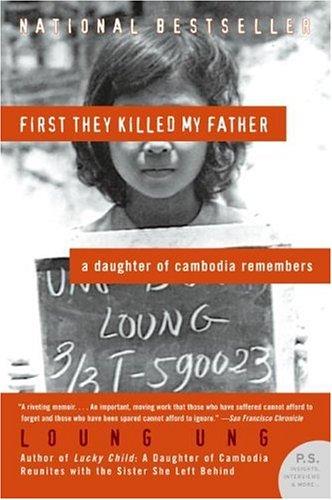
First They Killed My Father
2000
- childhood and youth
- political atrocities
- politics and government
- cambodia, politics and government
- cambodia, biography
- autobiography and memoir
- cambodia, history
- women, biography
- political science
- reading level-grade 11
The story
From a childhood survivor of the Camdodian genocide under the regime of Pol Pot, this is a riveting narrative of war crimes and desperate actions, the unnerving strength of a small girl and her family, and their triumph of spirit. One of seven children of a high-ranking government official, Loung Ung lived a privileged life in the Cambodian capital of Phnom Penh until the age of five. Then, in April 1975, Pol Pot's Khmer Rouge army stormed into the city, forcing Ung's family to flee and, eventually, to disperse. Loung was trained as a child soldier in a work camp for orphans, her siblings were sent to labor camps, and those who survived the horrors would not be reunited until the Khmer Rouge was destroyed. Harrowing yet hopeful, Loung's powerful story is an unforgettable account of a family shaken and shattered, yet miraculously sustained by courage and love in the face of unspeakable brutality.
What it’s like
Plain, unadorned sentences carry this memoir, the prose of a child's memory set down by an adult who has chosen to bear witness rather than to decorate. The sensory world is lean but stark: rice fields under a merciless sun, the hush of evacuation roads, the hunger that sharpens every smell and sound, and the flat terror of a work camp where small hands are given tasks no child should hold. Its voice is clear and direct, and its rhythm moves in short, deliberate passages with sudden pauses that let a scene sit heavy before the next begins. Violence is present and unflinching, including executions, starvation and the cruelty of soldiers toward children, but it is described without lurid detail, so the dread comes from what is witnessed and survived rather than from gore. Emotional register swings between bleak grief and quiet, stubborn tenderness, especially in the bond between a young girl and her siblings. The arc follows a family scattered by war and a child who must grow up far too fast, holding on to love as the one thing no regime can take. This suits readers who want a serious, moving account of history told through a single intimate life, best read in a steady, unhurried sitting rather than as comfort reading. It is for readers drawn to survivor testimony and to resilience written without sentimentality.
More books like First They Killed My Father
Closest in mood, pacing and theme. Tell us why you loved First They Killed My Fatherand we’ll explain which ones fit you.