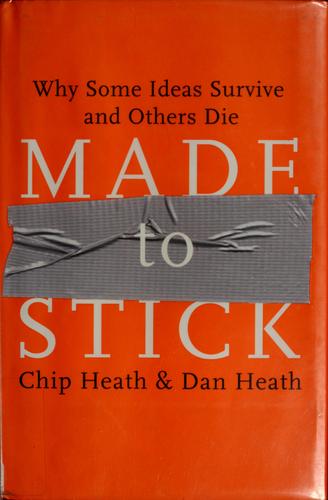
Made to stick
1998
- business
- contagion (social psychology)
- context effects (psychology)
- nonfiction
- psychiatry & psychology
- psychology
- social psychology
- success in business
- interpersonal communication
- idea (philosophy)
The story
Mark Twain once observed, "A lie can get halfway around the world before the truth can even get its boots on." His observation rings true: Urban legends, conspiracy theories, and bogus public-health scares circulate effortlessly. Meanwhile, people with important ideas--business people, teachers, politicians, journalists, and others--struggle to make their ideas "stick." Why do some ideas thrive while others die? And how do we improve the chances of worthy ideas? In Made to Stick, accomplished educators and idea collectors Chip and Dan Heath tackle head-on these vexing questions. Inside, the brothers Heath reveal the anatomy of ideas that stick and explain ways to make ideas stickier, such as applying the "human scale principle," using the "Velcro Theory of Memory," and creating "curiosity gaps."In this indispensable guide, we discover that sticky messages of all kinds--from the infamous "kidney theft ring" hoax to a coach's lessons on sportsmanship to a vision for a new product at Sony--draw their power from the same six traits.Made to Stick is a book that will transform the way you communicate ideas. It's a fast-paced tour of success stories (and failures)--the Nobel Prize-winning scientist who drank a glass of bacteria to prove a point about stomach ulcers; the charities who make use of "the Mother Teresa Effect"; the elementary-school teacher whose simulation actually prevented racial prejudice. Provocative, eye-opening, and often surprisingly funny, Made to Stick shows us the vital principles of winning ideas--and tells us how we can apply these rules to making our own messages stick.From the Hardcover edition.
What it’s like
Brisk, anecdote-packed nonfiction with a bright, conversational voice, the kind of book that reads like a well-organised talk from a sharp friend who loves good stories. The prose is plain and friendly, full of short scenes set in hospital wards, classrooms and corporate boardrooms, with the occasional wry aside that keeps it light. Chapters move quickly, each one building a principle from a vivid example, so it suits a long-haul flight, a lazy weekend afternoon, or a few chapters before bed when you want to finish something satisfying in one sitting. The emotional register is curious and optimistic rather than heavy, and the reader's sense of progress comes from gradually seeing a pattern click into place. Intensity is low: a few mentions of hoaxes, public-health scares and dark historical episodes, but nothing graphic or distressing. It is for people who want practical, enjoyable ideas about communication, teaching or persuasion, and who like their lessons delivered through good stories rather than dry theory.
More books like Made to stick
Closest in mood, pacing and theme. Tell us why you loved Made to stickand we’ll explain which ones fit you.