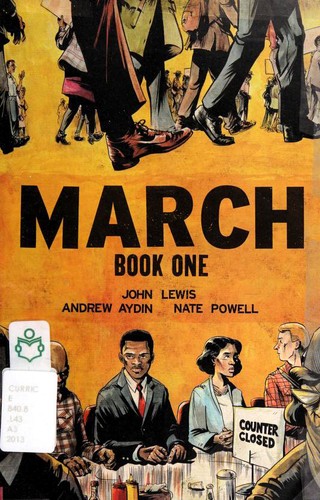
March. Book One
2013
- sit-ins
- nonviolence
- social gospel
- montgomery advertiser
- brown v. board of education of topeka
- gospel of john
- racial segregation
- legislators
- civil rights workers
- civil rights movement
The story
March is a vivid first-hand account of John Lewis’ lifelong struggle for civil and human rights, meditating in the modern age on the distance traveled since the days of Jim Crow and segregation. Rooted in Lewis’ personal story, it also reflects on the highs and lows of the broader civil rights movement. Book One spans John Lewis’ youth in rural Alabama, his life-changing meeting with Martin Luther King, Jr., the birth of the Nashville Student Movement, and their battle to tear down segregation through nonviolent lunch counter sit-ins, building to a stunning climax on the steps of City Hall. Many years ago, John Lewis and other student activists drew inspiration from the 1950s comic book "Martin Luther King and the Montgomery Story." Now, his own comics bring those days to life for a new audience, testifying to a movement whose echoes will be heard for generations. --back flap
What it’s like
Stark black-and-white ink, with heavy hatching, scratchy textured linework, and sharp contrast between deep shadow and blank white, gives this graphic memoir a grave, watchful look. Scenes unfold in tight grids and intimate close-ups: a boy's rural Alabama childhood in sun-bleached fields, the hush of a church basement, the crowded, humming lunch counters of Nashville where students sit very still while the world around them tightens. The mood is solemn and determined, with a steady undercurrent of hope rather than despair, and the pacing is deliberate, moving between quiet reflection and sudden, tense bursts of action. Violence is present and occasionally brutal, with students beaten, doused, and dragged, but it is drawn in plain, restrained panels with no gore, so the impact comes from weight and consequence rather than spectacle. Its people are shaped by conviction and patience, and its arc follows a young man learning that discipline and nonviolence can carry real force. It suits a slow, attentive afternoon read, a history-minded reader, or anyone wanting a clear-eyed account of civic courage for readers of all ages, especially teens and adults who enjoy visual storytelling.
More books like March. Book One
Closest in mood, pacing and theme. Tell us why you loved March. Book Oneand we’ll explain which ones fit you.