Northern Lights
1995
- political theology
- polar bears
- kidnapping
- adventure stories
- children and adults
- juvenile fiction
- fantasy
- experiments
- witches
- missing persons
The story
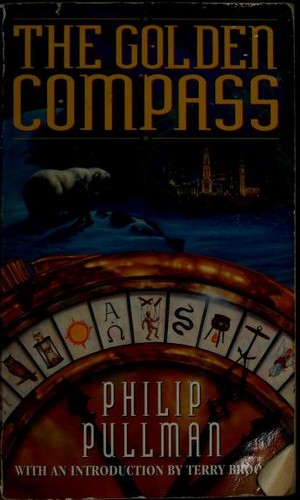
In a landmark epic of fantasy and storytelling, Philip Pullman invites readers into a world as convincing and thoroughly realized as Narnia, Earthsea, or Redwall. Here lives an orphaned ward named Lyra Belacqua, whose carefree life among the scholars at Oxford's Jordan College is shattered by the arrival of two powerful visitors. First, her fearsome uncle, Lord Asriel, appears with evidence of mystery and danger in the far North, including photographs of a mysterious celestial phenomenon called Dust and the dim outline of a city suspended in the Aurora Borealis that he suspects is part of an alternate universe. He leaves Lyra in the care of Mrs. Coulter, an enigmatic scholar and explorer who offers to give Lyra the attention her uncle has long refused her. In this multilayered narrative, however, nothing is as it seems. Lyra sets out for the top of the world in search of her kidnapped playmate, Roger, bearing a rare truth-telling instrument, the compass of the title. All around her children are disappearing—victims of so-called "Gobblers"—and being used as subjects in terrible experiments that separate humans from their daemons, creatures that reflect each person's inner being. And somehow, both Lord Asriel and Mrs. Coulter are involved.
What it’s like
Cold, bright and sprawling, with the warm clutter of an Oxford college giving way to the blank white of the Arctic: candlelit high-table dinners and soot-dark cobbled streets, then wind-scoured ice, aurora-green skies and the low gleam of a northern town. The prose is confident and brisk, full of Victorian-flavoured wit and sharp, sensory detail (fur, frost, the grain of old paper), with chapters that snap along quickly and cliffhang often. The score-like rhythm of its action sequences contrasts with quieter scenes of a girl eavesdropping, lying and scheming among adults. Its intensity sits in the middle: peril, kidnapping and a chilling strand of child experiments, handled with unflinching seriousness but little on-page gore, and a few brutal moments in fights with armoured bears and battles with the Gobblers. Emotionally it is restless and tender by turns, following a headstrong, defiant orphan who slowly discovers how much her elders have hidden from her. A good fit for readers who want an immersive, swashbuckling secondary-world adventure with a serious undertow, and for anyone who enjoyed the scale of classic children's fantasy.
More books like Northern Lights
Closest in mood, pacing and theme. Tell us why you loved Northern Lightsand we’ll explain which ones fit you.