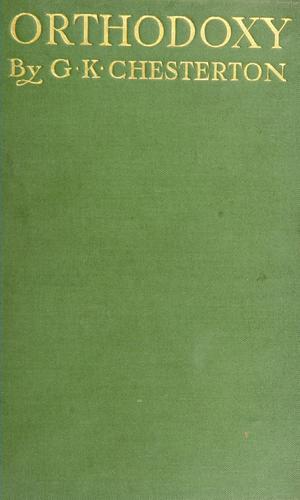
Orthodoxy
1874
- apologetics
- christianity
- history
- essence, genius, nature
- evidence
- nonfiction
- religion & spirituality
- essays
- christendom
- christianisme
The story
<p><i>Orthodoxy</i> is <a href="https://standardebooks.org/ebooks/g-k-chesterton">G. K. Chesterton’s</a> response to his critics’ assertion that his earlier collection of essays, <i><a href="https://standardebooks.org/ebooks/g-k-chesterton/heretics">Heretics</a></i>, had “merely criticised current philosophies without offering any alternative philosophy.” In his intellectual journey from pagan to agnostic to positivist philosopher, he had attempted to build a philosophy “some ten minutes in advance of the truth.” But when he compared his modern philosophy with Christian theology, he realized that he was “the man who with the utmost daring discovered what had been discovered before.” Thus, <i>Orthodoxy</i> is a work of Christian apologetics, where Chesterton tries to show that Christianity is a universal answer to the everyday needs of humanity, and not just an arbitrary philosophy handed down from on high.</p>
What it’s like
Dense but buoyant prose, paradox turning over on itself every few sentences, the reading experience of a brilliant talker who is delighted by his own argument and wants you delighted too. Chesterton's voice here is conversational and combative, full of sudden images (a fence, a lunatic's logic, a madman's tidy system) that snap a half-formed idea into focus, so the book rewards a slow, underlined read rather than a skim. The mood is sunlit and combative, witty and warm rather than gloomy: a lively, unhurried argument pitched somewhere between a pub debate and a sermon, with frequent wry jokes at the expense of modern certainties. Nothing here is violent, sexual or frightening; its only sharpness is intellectual. It suits a rainy Sunday with a pot of tea, a slow reread on a train, or an evening when you want your mind pleasantly provoked rather than soothed. Its arc is the author's own: a restless modern mind circling back, with evident relish, to an inheritance it had dismissed. It is for readers who enjoy essays with personality, who like faith argued with wit and cheerful paradox, and for anyone curious why a clever skeptic might find the old doctrines more surprising than the new ones.
More books like Orthodoxy
Closest in mood, pacing and theme. Tell us why you loved Orthodoxyand we’ll explain which ones fit you.