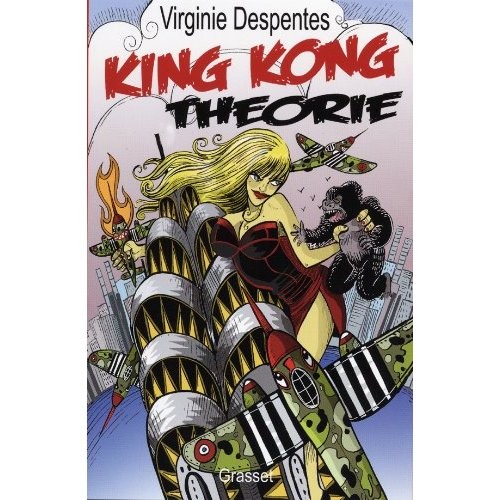
King Kong théorie
2006
- biographies
- écrivaines françaises
- french authors
- biography
- feminism
- sociology
- lgbtq biography and memoir
- lambda literary awards
- lambda literary award winner
- rape victims
The story
Out of print in the U.S. for far too long, writer and filmmaker Virginie Despentes’s autobiographical feminist manifesto is back―in an improved English translation―“blistering with anger, and so precisely phrased that it feels an injustice to summarize it” (Nadja Spiegelman, New York Review of Books). I write from the realms of the ugly, for the ugly, the old, the bull dykes, the frigid, the unfucked, the unfuckable, the hysterics, the freaks, all those excluded from the great meat market of female flesh. And if I’m starting here it’s because I want to be crystal clear: I’m not here to make excuses, I’m not here to bitch. I wouldn’t swap places with anyone because being Virginie Despentes seems to me a more interesting gig than anything else out there. Powerful, provocative, and personal, King Kong Theory is a candid account of how the author of Baise-Moi and Vernon Subutex came to be Virginie Despentes. Drawing from personal experience, Despentes shatters received ideas about rape and prostitution, and explodes common attitudes about sex and gender. An autobiography, a call for revolt, a manifesto for a new punk feminism, King Kong Theory is Despentes’s most beloved and reviled work, and is here made available again in a brilliant new translation by Frank Wynne.
What it’s like
Blunt, profane, and fast, the prose reads like a punk zine that has grown up and kept its temper: short declarative sentences, sudden digressions into memory, and a direct-address voice that talks to the reader as if across a bar table. Its sensory world is mostly urban and nocturnal, with cheap clubs, stale cigarette smoke, late-night streets, and the grit of 1990s Paris and provincial Nancy, rendered in clipped, unvarnished detail. The mood is raw and combative, with flashes of dark humour and an underlying weariness, best suited to a restless evening alone, a long train ride, or a reader who wants writing that bites back. Its intensity is high: frank discussion of sex, prostitution, and rape, including the author's own experience, with the violence described plainly rather than lingered over, and nothing gentle about its anger or its language. Arc-wise it is less a story than a sequence of arguments and self-portraits, moving from memoir into polemic about gender, desire, and who gets treated as disposable. It is for readers who want feminist writing that refuses politeness, who enjoy punk attitude and provocation, and who can handle explicit, uncomfortable material without flinching.
More books like King Kong théorie
Closest in mood, pacing and theme. Tell us why you loved King Kong théorieand we’ll explain which ones fit you.