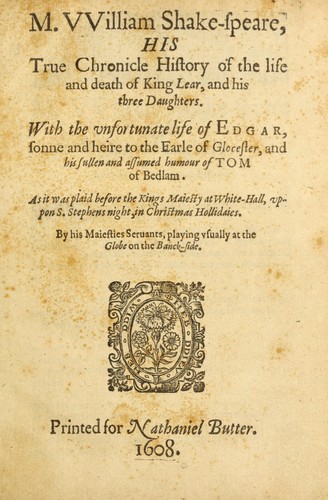
King Lear
1608
- drama
- king lear (legendary character)
- fathers and daughters
- kings and rulers
- inheritance and succession
- britons
- aging parents
- stage history
- textual criticism
- lear, king (legendary character)
The story
King Lear divides his kingdom among the two daughters who flatter him and banishes the third one who loves him. His eldest daughters both then reject him at their homes, so Lear goes mad and wanders through a storm. His banished daughter returns with an army, but they lose the battle and Lear, all his daughters and more, die. ([source][1]) [1]: https://www.shakespeare.org.uk/explore-shakespeare/shakespedia/shakespeares-plays/king-lear/
What it’s like
Bleak, storm-battered and unrelenting, with a dry, rhythmic verse that shifts between courtly formality and raw, broken speech. Its sensory world is largely elemental: howling wind and rain on a heath, cold stone halls, torchlight flickering over fools and beggars, and long stretches of stark, almost bare stage space where the emotional weather does the work. The vibe is grief-heavy and tempestuous, with flashes of savage irony and a few tender, quiet moments that feel almost unbearably exposed. Reading it is a slow, cumulative experience: the blank-verse lines build in waves, scenes sometimes collapse into fragmentary exchanges, and the pace accelerates toward a final act of cruelty and loss. Intensity is high: a blinding, a hanging, and a closing sequence of deaths, all rendered in direct, unsparing language, with violence more implied and spoken than lovingly detailed. It is not gentle reading and offers little comfort, but it suits a late-night, solitary reader who wants a full-scale study of ageing, pride, and filial betrayal. It is for people who want their tragedy unflinching, dense with language, and emotionally severe.
More books like King Lear
Closest in mood, pacing and theme. Tell us why you loved King Learand we’ll explain which ones fit you.