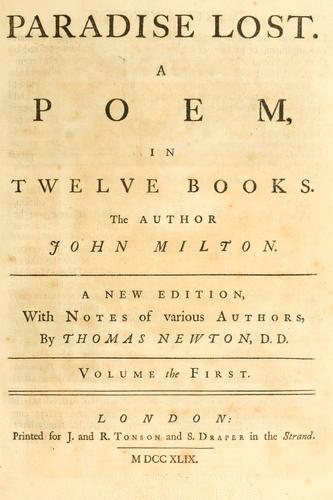
Paradise Lost
1667
- bible
- biography
- criticism and interpretation
- devil
- early works to 1800
- english christian poetry
- english epic poetry
- english poetry
- fall of man
- fall of man in literature
The story
John Milton's Paradise Lost is one of the greatest epic poems in the English language. It tells the story of the Fall of Man, a tale of immense drama and excitement, of rebellion and treachery, of innocence pitted against corruption, in which God and Satan fight a bitter battle for control of mankind's destiny. The struggle rages across three worlds - heaven, hell, and earth - as Satan and his band of rebel angels plot their revenge against God. At the center of the conflict are Adam and Eve, who are motivated by all too human temptations but whose ultimate downfall is unyielding love. Marked by Milton's characteristic erudition, Paradise Lost is a work epic both in scale and, notoriously, in ambition. For nearly 350 years, it has held generation upon generation of audiences in rapt attention, and its profound influence can be seen in almost every corner of Western culture.
What it’s like
Dense, sonorous blank verse that rolls like organ music across long, unbroken sentences, with the sense of vast cathedral space: heaven rendered as gleaming gold and burnished light, hell as sulphurous smoke and ruined fire, Eden as lush, dappled bowers of flowers, fruit, and cool water. The prose-poem texture is rich with classical allusion and catalogues of names and places, so reading it feels like walking through a vaulted, candlelit hall where every pillar is carved. Its vibe is stately, grand, and brooding, with a slow, weighty rhythm that rewards long, unhurried sittings: a quiet evening, a long train ride, or a patient reread with a dictionary close at hand. Violence is epic and mostly offstage or bloodless, as angels clash in cosmic battle and sin brings sorrow rather than gore; there is no sexual content, and the fear is theological dread more than shock. Emotionally it moves from defiant pride and seductive rhetoric toward grief, repentance, and a tender, hard-won hope, following Satan's fury and Adam and Eve's fragile, loving bond. It suits readers who love high literary style, religious and philosophical grandeur, and the slow pleasure of language built to be read aloud.
More books like Paradise Lost
Closest in mood, pacing and theme. Tell us why you loved Paradise Lostand we’ll explain which ones fit you.