The Restaurant at the End of the Universe
1980
- fiction
- humorous fiction
- humorous stories
- interplanetary voyages
- restaurants
- science fiction
- interstellar travel
- life on other planets
- prefect, ford (fictitious character), fiction
- dent, arthur (fictitious character), fiction
The story
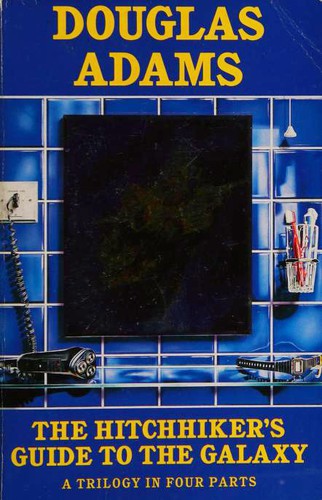
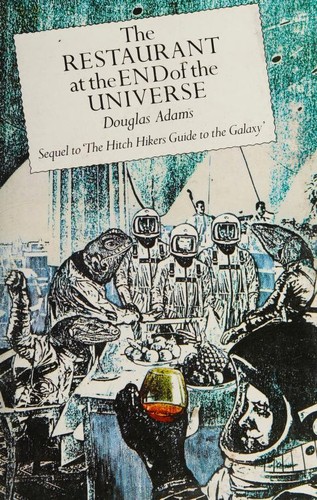
The Restaurant at the End of the Universe is the second book in the Hitchhiker's Guide to the Galaxy comedy science fiction "trilogy" by Douglas Adams, and is a sequel. It was originally published by Pan Books as a paperback. The book was inspired by the song "Grand Hotel" by British rock band Procol Harum. The book title refers to Milliways, the Restaurant at the End of the Universe, one of the settings of the book. ---------- Also contained in: - [The Hitch Hiker's Guide to the Galaxy: A Trilogy in Four Parts][2] - [The More Than Complete Hitchhiker's Guide][3] - [Ultimate Hitchhiker's Guide to the Galaxy](https://openlibrary.org/works/OL2163706W) [1]: http://www.douglasadams.com/creations/0345391810.html [2]: https://openlibrary.org/works/OL2163692W [3]: https://openlibrary.org/works/OL2163713W
What it’s like
Brisk, deadpan sentences that snap along like a well-timed punchline, with the prose voice doing most of the work: dry British narration, sudden digressions, and absurd lists delivered with a straight face. Its sensory world is spaceships, improbable bars, and the blank cold of deep space, rendered through quick cuts of description rather than lingering atmosphere, so it reads more like a sketchbook than a painting. The vibe is wry, bemused and cheerfully unhurried, a sharp comic spin on cosmic loneliness; it suits a rainy Sunday with a cup of tea, a comfort reread, or a long-haul flight where you want to laugh out loud without trying. Pacing is episodic and loose, with chapters that hop between planets and bail out of crises just as they peak. Emotionally it stays light: its two lost travellers, one bewildered Earthman and one lovably scatterbrained companion, drift through the universe more by accident than design, slowly growing into a friendship that is more loyal than sentimental. Violence is slapstick and brief, with occasional threats and a few flat-toned deaths that land as jokes rather than horror; there is no sexual content and no gore. It is for readers who want gentle, clever absurdity and a little warmth, and who enjoy science fiction that mocks its own grandeur.
More books like The Restaurant at the End of the Universe
Closest in mood, pacing and theme. Tell us why you loved The Restaurant at the End of the Universeand we’ll explain which ones fit you.
- Novels (Hitch Hiker's Guide to the Galaxy / Restaurant at the End of the Universe / Life, the Universe and Everything / So Long, and Thanks for All the Fish)1979 · Book
- Life, the Universe and Everything1982 · Book
- Works (Hitch Hiker's Guide to the Galaxy / Restaurant at the End of the Universe / Life, the Universe and Everything / So Long, and Thanks for All the Fish / Mostly Harmless / Young Zaphod Plays it Safe)1996 · Book
- So long, and thanks for all the fish1984 · Book
- The Hitchhiker's Guide to the Galaxy1979 · Book
- Neutron Star1968 · Book
- The End of Eternity1955 · Book
- 20011968 · Book