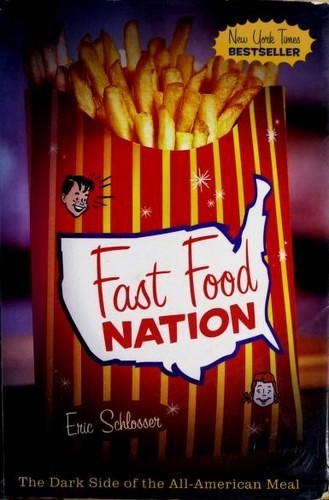
Fast Food Nation
2001
- politics
- health
- current events
- sociology
- mcdonald's
- food
- american cooking
- social science
- popular culture
- cooking
The story
To a degree both engrossing and alarming, the story of fast food is the story of postwar Amerca. Though created by a handful of mavericks, the fast food industry has triggered the homogenization of our society. Fast food has hastened the malling of our landscape, widened the chasm between rich and poor, fueled an epidemic of obesity, and propelled the juggernaut of American cultural imperialism abroad. That's a lengthy list of charges, but Eric Schlosser makes them stick with an artful mix of first-rate reportage, wry wit, and careful reasoning. Schlosser's myth-shattering survey stretches from the California subdivisions where the business was born to the industrial corridor along the New Jersey Turnpike where many of fast food's flavors are concocted. He hangs out with the teenagers who make the restaurants run and communes with those unlucky enough to hold America's most dangerous job -- meatpacker. He travels to Las Vegas for a giddily surreal franchisers' convention where Mikhail Gorbachev delivers the keynote address. He even ventures to England and Germany to clock the rate at which those countries are becoming fast food nations. Along the way, Schlosser unearths a trove of fascinating, unsettling truths -- from the unholy alliance between fast food and Hollywood to the seismic changes the industry has wrought in food production, popular culture, and even real estate. He also uncovers the fast food chains' efforts to reel in the youngest, most susceptible consumers even while they hone their institutionalized exploitation of teenagers and minorities. Schlosser then turns a critical eye toward the hot topic of globalization -- a phenomenon launched by fast food. FAST FOOD NATION is a groundbreaking work of investigation and cultural history that may change the way America thinks about the way it eats.
What it’s like
Brisk, plain-spoken investigative prose with a dry, wry edge, the kind of book that reads like a long magazine feature with a reporter's notebook open on the page. Its world is strip-mall parking lots under flat fluorescent light, the humming industrial corridors of northern New Jersey, the cold and din of a meatpacking plant, and the glossy, overlit banality of a franchisers' convention in Las Vegas, all rendered with precise, unsentimental detail rather than lush description. Its vibe is alarmed curiosity and steady indignation, best suited to a long-haul flight, a slow weekday commute, or a focused evening when you want to be informed and a little unsettled. The pacing is brisk and chapter-driven, moving from one case study to the next, and the emotional register swings between wry amusement and grim seriousness, with the most affecting passages given to the teenagers working the counters and the workers who cut meat for a living. Expect frank discussion of animal slaughter, workplace injuries, and food-safety disasters described in documentary detail; the violence is real but reported rather than dramatised, and there is no sexual content. Written for readers who want to understand how American eating, work and towns were reshaped, and for those who enjoy investigative nonfiction with a clear moral point of view.
More books like Fast Food Nation
Closest in mood, pacing and theme. Tell us why you loved Fast Food Nationand we’ll explain which ones fit you.