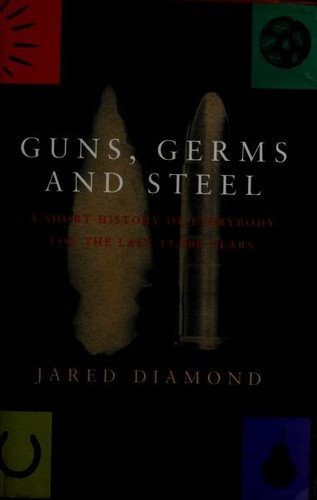
Guns, Germs, and Steel
1997
- prize:pulitzer=1998
- ethnology
- criticism and interpretation
- culture diffusion
- effect of environment on
- civilization
- human beings
- social evolution
- history
- sociale evolutie
The story
An epic detective story that offers a gripping expose on why the world is so unequal. Professor Jared Diamond traveled the globe for over 30 years trying to answer this question.
What it’s like
Expansive and unhurried, with the texture of a field notebook: long passages of patient reasoning, maps and charts mentally unrolling across tropical coastlines, New Guinea highlands, and Eurasian plains. The prose is clear and conversational, more lecturer than novelist, with an easy curiosity that keeps circling back to the same big question. Its vibe is cerebral and warmly absorbing, a book for slow evenings and a long-haul flight when you want to be carried by ideas rather than scenes. The pace is steady and digressive, building a layered argument chapter by chapter, with a sense of a restless mind pleased by connections across continents and millennia. The emotional register stays measured and wry, with moments of wonder at ordinary plants and animals turning out to matter enormously. Intensity is low: violence and cruelty appear only as historical fact, discussed analytically rather than dramatised, with no gore or graphic detail. It suits readers who enjoy popular science, deep history and big-picture explanations of how societies came to be.
More books like Guns, Germs, and Steel
Closest in mood, pacing and theme. Tell us why you loved Guns, Germs, and Steeland we’ll explain which ones fit you.