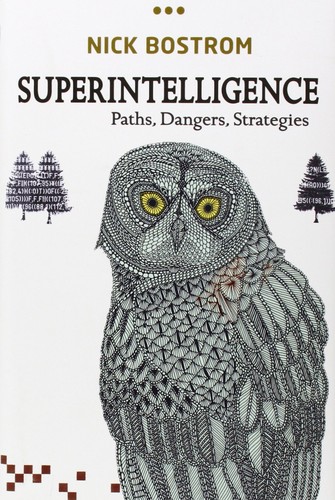
Superintelligence
2014
- moral and ethical aspects
- cognitive science
- artificial intelligence
- social aspects
- philosophy
- computers and civilization
- intelligence artificielle
- philosophie
- aspect social
- aspect moral
The story
The human brain has some capabilities that the brains of other animals lack. It is to these distinctive capabilities that our species owes its dominant position. Other animals have stronger muscles or sharper claws, but we have cleverer brains. If machine brains one day come to surpass human brains in general intelligence, then this new superintelligence could become very powerful. As the fate of the gorillas now depends more on us humans than on the gorillas themselves, so the fate of our species then would come to depend on the actions of the machine superintelligence. But we have one advantage: we get to make the first move. Will it be possible to construct a seed AI or otherwise to engineer initial conditions so as to make an intelligence explosion survivable? How could one achieve a controlled detonation? To get closer to an answer to this question, we must make our way through a fascinating landscape of topics and considerations. Read the book and learn about oracles, genies, singletons; about boxing methods, tripwires, and mind crime; about humanity's cosmic endowment and differential technological development; indirect normativity, instrumental convergence, whole brain emulation and technology couplings; Malthusian economics and dystopian evolution; artificial intelligence, and biological cognitive enhancement, and collective intelligence.
What it’s like
Dense, unhurried nonfiction written in a precise, faintly wry academic voice, with long sentences that stack qualifications and then land on a striking analogy. Its texture is cerebral and cool rather than sensory: no scenes or landscapes, just the sustained feel of a lamp-lit study late at night, pages of careful argument, numbered considerations, and thought experiments that unfold slowly one after another. The pace is deliberate and essayistic, circling back to revisit an idea from a new angle, with frequent sections that map out possibilities before weighing them. Its emotional register is sober and alert, a background hum of unease about the future held at arm's length by intellectual curiosity rather than dread, and there is no violence, gore, or sexual content, though the stakes discussed are civilizational and occasionally grim in their logic. It suits a slow weekend afternoon with a notebook nearby, a long train journey, or an evening when you want your mind pulled outward toward large questions without any plot to chase. It is for readers who enjoy patient philosophical argument, people curious about how minds, machines, and human futures might intersect, and anyone who likes thinking through hard scenarios on the page.
More books like Superintelligence
Closest in mood, pacing and theme. Tell us why you loved Superintelligenceand we’ll explain which ones fit you.