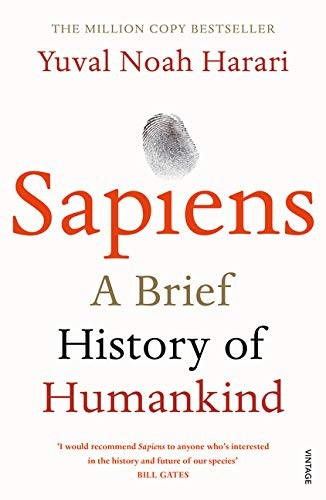
Sapiens
2011
- technology and civilization
- human beings
- historical chronology
- historia universal
- historia
- civilization
- hombre
- world history
- history
- non-fiction
The story
From a renowned historian comes a groundbreaking narrative of humanity’s creation and evolution—a #1 international bestseller—that explores the ways in which biology and history have defined us and enhanced our understanding of what it means to be “human.” One hundred thousand years ago, at least six different species of humans inhabited Earth. Yet today there is only one—homo sapiens. What happened to the others? And what may happen to us? Most books about the history of humanity pursue either a historical or a biological approach, but Dr. Yuval Noah Harari breaks the mold with this highly original book that begins about 70,000 years ago with the appearance of modern cognition. From examining the role evolving humans have played in the global ecosystem to charting the rise of empires, Sapiens integrates history and science to reconsider accepted narratives, connect past developments with contemporary concerns, and examine specific events within the context of larger ideas. Dr. Harari also compels us to look ahead, because over the last few decades humans have begun to bend laws of natural selection that have governed life for the past four billion years. We are acquiring the ability to design not only the world around us, but also ourselves. Where is this leading us, and what do we want to become? Featuring 27 photographs, 6 maps, and 25 illustrations/diagrams, this provocative and insightful work is sure to spark debate and is essential reading for aficionados of Jared Diamond, James Gleick, Matt Ridley, Robert Wright, and Sharon Moalem.
What it’s like
Brisk, sweeping and conversational, with the feel of a lecturer pacing a lit stage and talking straight to you: short declarative sentences, wry asides, and bold provocations that arrive one after another like slides clicking forward. The prose is clean and modern rather than ornate, built on analogies and rhetorical questions, so it reads quickly and rarely drags. Its register is curious and a little bracing, the mood of a good late-night argument in a warm kitchen, where big ideas about farming, money, empire and the future are turned over with a dry grin. The book is illustrated with maps, diagrams and photographs, so the pages break up visually, and the reading rhythm suits short sittings on a commute or a long-haul flight. It carries no graphic violence or sexual content; the darkness is intellectual, in its unsettling claims about how little humans may have chosen their own path. It suits readers who enjoy big-picture history and popular science, the curious and the skeptical alike, and anyone wanting a provocative, unhurried overview of what it means to be human.
More books like Sapiens
Closest in mood, pacing and theme. Tell us why you loved Sapiensand we’ll explain which ones fit you.