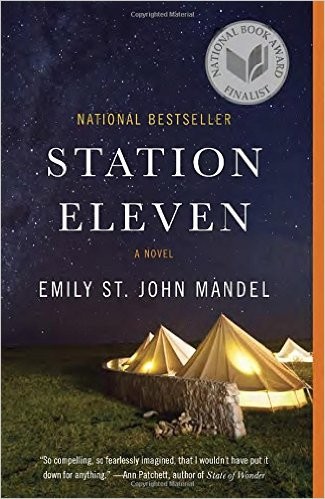
Station Eleven
2014
- fiction
- literary
- science fiction
- actors
- adventure
- amerikanisches englisch
- time travel
- shakespearean actors and actresses
- symphonies
- traveling theater
The story
One snowy night Arthur Leander, a famous actor, has a heart attack onstage during a production of "King Lear." Jeevan Chaudhary, a paparazzo-turned-EMT, is in the audience and leaps to his aid. A child actress named Kirsten Raymonde watches in horror as Jeevan performs CPR, pumping Arthur's chest as the curtain drops, but Arthur is dead. That same night, as Jeevan walks home from the theater, a terrible flu begins to spread. Hospitals are flooded and Jeevan and his brother barricade themselves inside an apartment, watching out the window as cars clog the highways, gunshots ring out, and life disintegrates around them. Fifteen years later, Kirsten is an actress with the Traveling Symphony. Together, this small troupe moves between the settlements of an altered world, performing Shakespeare and music for scattered communities of survivors. Written on their caravan, and tattooed on Kirsten's arm is a line from Star Trek: "Because survival is insufficient." But when they arrive in St. Deborah by the Water, they encounter a violent prophet who digs graves for anyone who dares to leave. In a future in which a pandemic has left few survivors, actress Kirsten Raymonde travels with a troupe performing Shakespeare and finds herself in a community run by a deranged prophet. The plot contains mild profanity and violence.
What it’s like
Quiet, unhurried prose that moves between two time frames: a snowy theater night in the old world and the sparse, wind-scoured world fifteen years on. The voice is clean and observant, drawn to small domestic details, the glow of a stage, the ordinary objects that survive a collapse. The tone is elegiac and wistful, with a steady undercurrent of unease that rises when the story turns toward a settlement ruled by menace. Violence is present but not lingered on: some gunfire and brief, sharp acts of cruelty, a few dark scenes of grave-digging and threat, with mild profanity and no gore for its own sake. The pacing is patient, built from short chapters that hop between characters and years, so the reader gets a mosaic of connected lives rather than one straight run. It is best suited to a slow Sunday, a long flight, or a reflective evening, for readers who want melancholy and beauty in a post-collapse world, music and theater as lifelines, and a gentle, human-centred sense of hope.
More books like Station Eleven
Closest in mood, pacing and theme. Tell us why you loved Station Elevenand we’ll explain which ones fit you.